Jester is Mewgenics’ high-variance class. I get the best results when I use its extra reroll and unpredictable tools to find one real payoff instead of treating randomness itself as the build.
Quick answer: Jester is strongest when its flexibility turns into something concrete. Use the extra Level Up Reroll to search for a coherent direction, then commit when the run gives you a real payoff such as Goofball action economy, Super Luck item scaling, or a strong random-spell package. The main mistake is assuming every random effect belongs in the same build.
Jester at a Glance
| Jester Trait | Current Value |
|---|---|
| Class identity | Flexibility / high variance |
| Class bonus | +1 Level Up Reroll |
| Class debuffs | None |
| Unlock | Beat The Rift |
| Native active abilities | 4 |
| Native passives | 2 |
| Best at | Adapting around rerolls, extra turns, extreme Luck, random buffs, and random spell value |
| Main weakness | Unpredictable effects are weak when the build has no concrete payoff |
Jester is unusual because its class identity is not built around one damage type or one fixed combat role.
Its native kit gives you random displacement, random buffs, unpredictable damage, random spells, extra turns, and an extreme Luck passive. That gives the class a high ceiling, but only if one of those systems starts feeding a repeatable plan.
How to Unlock Jester
Jester unlocks after beating The Rift.
Unlike classes that begin with a straightforward stat bonus and penalty package, Jester’s class bonus is +1 Level Up Reroll and it does not have a listed class debuff.
That extra reroll matters because Jester benefits more than most classes from finding a real direction instead of accepting every unusual option that appears.
Jester Ability Progression
Jester’s native progression is unusually compact.
| Step | Unlock | Requirement |
|---|---|---|
| 1 | Jester class | Beat The Rift |
| 2 | Bump, Power Up, RNG Cannon, Smart Metronome | Complete The Caves with Jester |
| 3 | Goofball and Super Luck | Complete The Boneyard with Jester |
The important part is that unlocking Jester does not immediately give you its whole native package.
The active and passive pools open through later progression, so a fresh Jester does not yet represent the fully developed version of the class.
Jester Active Abilities
Jester has four native active abilities. They all reinforce the same basic identity: you are paying for flexibility and upside rather than a perfectly predictable result.
| Ability | Cost | Core Effect | Upgrade | What It Means for Jester |
|---|---|---|---|---|
| Bump | 1 Mana | Displaces a target unit to a random location | If the target is an enemy, also deals 1 damage | Cheap board disruption |
| Power Up | All Mana | Spends all current mana and gives Jester that many random buffs | Can give the buffs to Jester or another unit | Converts a large mana pool into a high-variance payoff turn |
| RNG Cannon | 10 Mana | Deals a random amount of Magic Damage and requires line of sight | Also inflicts random debuffs | Expensive high-variance damage and disruption |
| Smart Metronome | 5 Mana | Casts a random spell that is usually beneficial | Casts a random upgraded spell instead | Flexible spell value without a predictable outcome |
These four abilities should not be evaluated the same way.
Bump is cheap enough to function as utility. Power Up and RNG Cannon are real commitments. Smart Metronome sits between them by trading exact control for flexible spell value.
How Jester Abilities Change Your Decisions
Bump Is Cheap Disruption
Bump costs only 1 mana, so I treat it primarily as a positioning tool rather than a damage spell.
Random displacement is not reliable enough for a precise combo, but it can still break a bad board state, remove a unit from an important tile, or create space when the current formation is working against you.
Because the cost is so low, Bump does not need to carry the build by itself to be useful.
Power Up Wants a Reason to Spend Everything
Power Up consumes all current mana and converts that amount into random buffs.
That means the important decision is not whether random buffs are good.
It is whether this is the turn where spending the entire mana pool produces more value than keeping access to Jester’s other spells.
I like Power Up much more when the rest of the turn is already stable and Jester can afford to cash out its mana for a high-upside buff package.
RNG Cannon Is a Commitment
RNG Cannon costs 10 mana and deals a random amount of Magic Damage.
The upgraded version also adds random debuffs.
I do not build around RNG Cannon as if the result were guaranteed. It becomes more attractive when the run already has enough mana and stability that one mediocre 10-mana result will not collapse the entire turn.
The spell has upside, but the build still needs enough structure to absorb bad variance.
Smart Metronome Is Flexible Value
Smart Metronome costs 5 mana and casts a random spell that is usually beneficial.
When upgraded, it casts a random upgraded spell.
This is one of the clearest expressions of Jester’s identity: you are not choosing the exact effect, so the build needs enough flexibility to use whatever useful result appears.
A team that desperately needs one specific answer every turn gets less value from this kind of randomness than a team that is already stable.
Jester Passives
Jester has two native passives, and both can change the class much more dramatically than another random spell.
| Passive | Core Effect | Upgrade | Build Role |
|---|---|---|---|
| Goofball | Take one extra turn at the start of each round | Gives two extra turns instead | Action economy |
| Super Luck | +21 Luck | +77 Luck | Extreme Luck scaling / item synergy |
These are much more concrete than the word “random” makes Jester sound.
Goofball gives direct action economy. Super Luck creates an unusually large stat value that external items can convert into real board or combat advantages.
Super Luck and the Luck Build
Super Luck is a native Jester passive.
The normal version gives +21 Luck, while the upgraded version gives +77 Luck.
That is large enough that I stop treating Luck as a background stat and start looking specifically for effects that convert it into something useful.
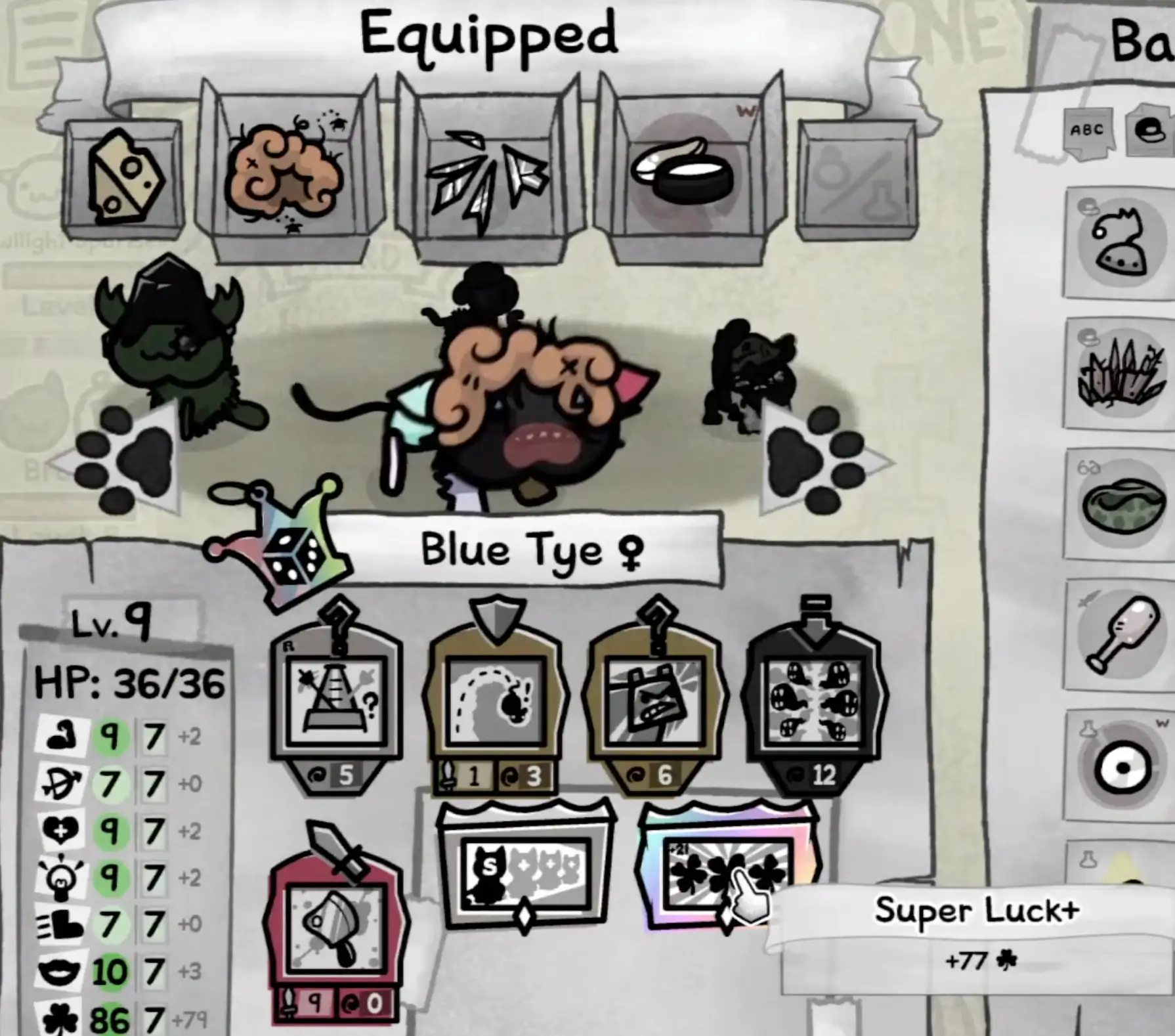
The important distinction is that Super Luck belongs to Jester, while the items that exploit it remain separate entities.
Mangy Wig
Mangy Wig is an external Head item that spawns one Spiderling for every 4 Luck at the start of each battle.
This is one of the clearest Super Luck synergies because the payoff scales directly from a stat Jester can push to an extreme value.
Mangy Wig is not part of Jester’s native kit. It is an item that gives Super Luck a concrete board-level payoff.
That distinction matters because I would not call Super Luck a finished build just because the Luck number is large. I want something that actually converts that number into useful value.
Libra
Libra is a Rare Trinket that balances all stats after stat modifiers are applied.
That makes it worth evaluating when Jester’s stat profile becomes extremely skewed.
Libra owns the stat-balancing mechanic, though. It should be treated as an item synergy rather than a Jester ability or passive.
Clown Makeup
Clown Makeup is a Very Rare Face item.
It costs 3 Luck but triples the effects of the equipped Head armor.
That becomes especially interesting when the Head slot already contains a scaling payoff such as Mangy Wig.
The real decision is whether tripling the Head effect is worth giving up some of the Luck that helped create the synergy in the first place.

This is another external item interaction, not part of Jester’s native class mechanics.
Skill Share Is Not a Jester Passive
One important distinction from older Jester build discussions:
Skill Share belongs to Collarless, not Jester.
Skill Share can still matter in a Jester-focused setup when cross-class or inherited passive combinations bring it into the build, but it should not be listed as part of Jester’s native passive pool.
Its normal effect shares the cat’s other passive with the rest of the party at the start of battle. The upgraded version also changes inheritance behavior when breeding.
Those complete mechanics belong to the Collarless / Skill Share owner rather than this Jester page.

For this page, the important conclusion is simply that Skill Share can support a Jester build without becoming a Jester-owned mechanic.
Best Jester Build Directions
Jester has several real directions, but they should be treated as responses to what the run gives you rather than fixed recipes.
Super Luck Item Engine
This is the clearest Jester-specific scaling direction because Super Luck is native to the class and provides an unusually large amount of Luck.
I commit when the run gives me an item that actually converts that Luck into something useful.
Mangy Wig is the obvious example: every 4 Luck creates another Spiderling at the start of battle.
Without that kind of payoff, a giant Luck number is not enough reason by itself to call the build finished.
The question is always:
What is this Luck actually doing for the run?
If the answer is nothing meaningful yet, I keep looking rather than assuming Super Luck alone has solved the build.
Goofball Action-Economy Jester
Goofball gives Jester an extra turn at the start of each round, with the upgraded version giving two.
This direction is less about one specific spell and more about finding enough useful things to do with those extra actions.
Mana, positioning, items, and the rest of the ability package all become more valuable when Jester can act more often.
The extra turns are the engine; the rest of the build determines whether those turns are actually productive.
Random Spell / Buff Jester
Power Up and Smart Metronome can create a build where Jester’s job is to turn mana into flexible, unpredictable value.
I prefer this direction when the rest of the team is already stable.
A party that desperately needs one exact answer every turn is a poor place to rely heavily on random spells and buffs.
This route gets better when almost any positive result can be used productively.
External Passive Synergy
Cross-class passive interactions can raise Jester’s ceiling, but I keep them conceptually separate from the native Jester kit.
Skill Share is the clearest example.
It may be useful in a Jester-focused setup, but it is still a Collarless passive. I treat that as an external layer added to the build rather than evidence that passive sharing is Jester’s native identity.
That distinction keeps the Class Owner accurate while still acknowledging real build combinations.
Jester Strengths and Weaknesses
| Strength | Why It Matters |
|---|---|
| +1 Level Up Reroll | Gives Jester more chances to find a coherent build direction |
| Flexible native abilities | Displacement, buffs, random damage, and random spell access let Jester adapt |
| Goofball action economy | Extra turns can dramatically increase the value of the rest of the build |
| Super Luck scaling | Creates unusually strong opportunities with Luck-dependent items |
| High build flexibility | Jester can pivot around whichever concrete payoff appears first |
| Weakness | What I Do About It |
|---|---|
| Unpredictable outcomes | Do not make the whole team depend on one exact random result |
| RNG Cannon costs 10 mana | Use it when the turn can survive a mediocre roll |
| Power Up consumes all current mana | Cash out only when the buff package is worth giving up other actions |
| Random value can lack direction | Look for a concrete payoff before committing the whole build |
| External synergies can blur class identity | Keep items and cross-class passives separate from Jester’s native kit |
Jester’s biggest strength and biggest weakness come from the same place.
The class gives you more ways to find unusual value, but it also makes it easy to collect individually interesting effects that never become one coherent plan.
Common Jester Mistakes
| Mistake | Better Rule |
|---|---|
| Treating randomness as the win condition | Random effects are tools; the build still needs a repeatable payoff |
| Calling external effects Jester abilities | Keep Skill Share, Libra, Mangy Wig, and Clown Makeup attached to their real owners |
| Spending all mana with no reason | Use Power Up only when the buff package is worth losing the rest of the mana pool |
| Ignoring the extra reroll | Use the additional Level Up Reroll to search for a coherent direction |
| Forcing one Jester archetype every run | Follow the strongest payoff the current run actually gives you |
The easiest way to weaken Jester is to mistake variety for synergy.
A build can contain several unusual effects and still have no real engine connecting them.
Is Jester Worth Using?
Jester is worth using when you enjoy adapting to unusual drafts and building around high-upside combinations instead of following one fixed combat role every run.
Goofball gives the class a concrete action-economy payoff.
Super Luck creates a concrete stat engine.
Power Up and Smart Metronome provide flexible but unpredictable spell value.
The extra Level Up Reroll gives you another chance to find the piece that makes one of those directions work.
The strongest Jester runs are not powerful because everything is random.
They are powerful because you eventually find a payoff strong enough that the randomness starts feeding one coherent plan.